
When Attic Insulation Needs Removing
Removal becomes necessary when the material above your ceiling has stopped being useful or has become a problem in its own right. Water damage, rodent contamination, compaction and general deterioration all fall into that category.
The judgement call matters here, because removal is a bigger job than topping up. We look at the actual condition of the material before recommending it.
Who Is This Service For?
This service suits homeowners whose existing attic insulation has reached the end of its useful life.
- Attics with rodent droppings or nesting material
- Insulation damaged by roof leaks or moisture
- Homes with very old, compacted insulation
- Attics being cleared ahead of a renovation
- Properties where a pest inspection recommended removal
What Attic Insulation Removal Involves
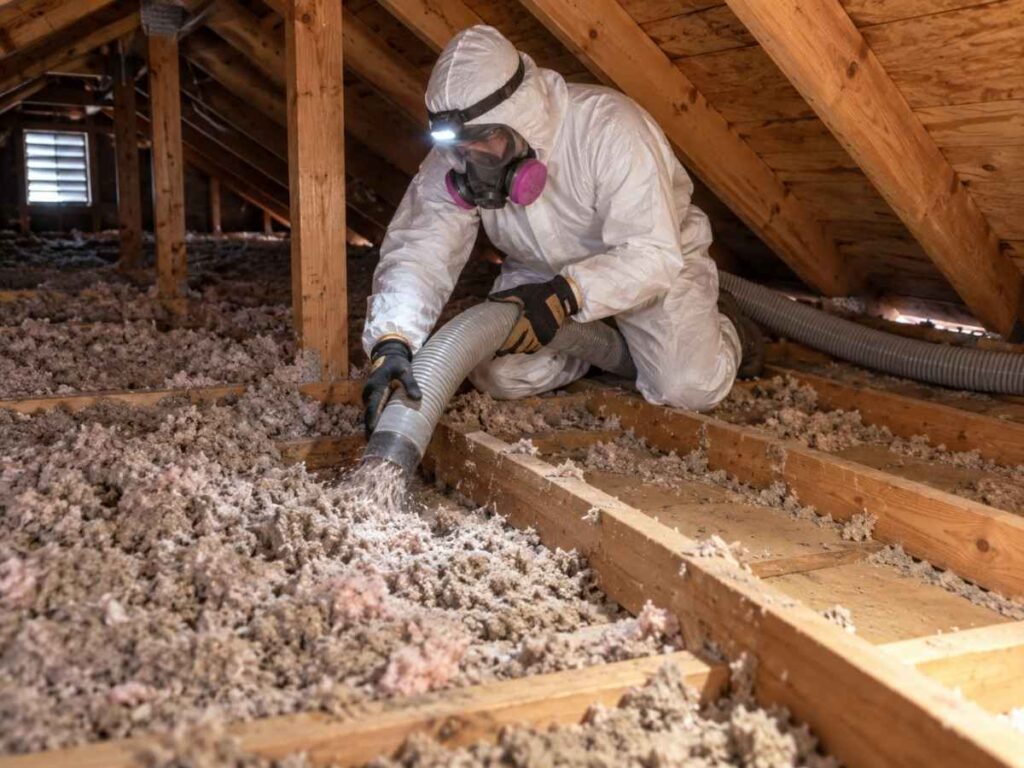
Getting old insulation out of an attic is dusty, awkward work, and the difference between a good job and a bad one is almost entirely about containment. The material has to come out through your house, so the route it travels matters as much as the removal itself.
We plan access and containment before anything is disturbed. Old insulation is bagged or vacuumed out and taken away rather than left for you to deal with.
How the Removal Runs
Here is what happens across a typical removal project.
- Condition assessment — We inspect the existing insulation to confirm removal is genuinely needed rather than assuming it.
- Containment setup — Access points and pathways are protected before any material is disturbed.
- Extraction — Old insulation is vacuumed or bagged out of the attic, working systematically across the space.
- Attic inspection — With the attic clear, we can see the decking, framing and any issues that were hidden underneath.
- Disposal and cleanup — The removed material is taken away and the access area is cleaned before we finish.
What We Often Find Underneath
An empty attic tells you things a full one cannot, which is part of the value of the process.
- Evidence of past leaks — Staining on decking or framing that was completely hidden under the insulation.
- Gaps and air paths — Openings around fixtures and penetrations that were never sealed.
- Rodent activity — Nesting, droppings or damage that indicates sanitization should follow.
- Wiring or structural issues — Things worth knowing about before new insulation covers them again.
How Removing Old Attic Insulation May Help
Clearing out failed insulation is rarely the end goal in itself. It is what makes everything afterwards possible, from a clean attic surface to insulation that performs the way it should.
Whether removal is followed by replacement is your call, and we will talk through both paths.
What Removal Makes Possible
These are the practical reasons homeowners go ahead with a full removal.
- A clean surface to build on — New insulation installed over damaged material rarely performs as intended.
- Contamination dealt with properly — Rodent-affected material is taken out rather than buried under a new layer.
- Hidden problems become visible — Leaks, gaps and damage can be identified while the attic is clear.
- An accurate starting point — With the space empty, the right depth and type of new insulation can be planned properly.
Attic Insulation Removal at Green Leaf Insulation
Removal is the service homeowners come to us for most often, and it is also the one where the process matters most. Contaminated or deteriorated material passing through a house needs to be handled carefully, and that is the part a rushed job gets wrong.
Being family-run means we treat the route through your home the way we would want ours treated. If we get into the attic and find the existing insulation is actually salvageable, we will tell you that rather than proceeding with a removal you do not need.
Frequently Asked Questions
How do I know if my attic insulation needs to be removed?
Visible contamination, water staining, a strong odour or heavily compacted material are the usual indicators. Insulation that is simply thin or settled can often be topped up instead, which is a smaller job. An assessment is the only reliable way to tell the two situations apart.
How much does attic insulation removal cost in Florence?
Cost depends on the size of the attic, how accessible it is, and what condition the material is in. Contaminated insulation generally takes longer to handle than dry material in good condition. We will give you a firm figure after seeing the space rather than a range over the phone.
Do I have to replace the insulation after it is removed?
Not immediately, though most homeowners do, since an uninsulated attic leaves the house noticeably harder to keep comfortable. Some people remove first and replace after other attic work is finished. We can handle removal on its own or as part of a removal and replacement project.
How messy is attic insulation removal?
Some dust is unavoidable, which is exactly why containment is planned before anything is touched. Access points and pathways are protected, and material is contained on its way out of the house. Cleanup of the access area is part of the job.
How long does removing attic insulation take?
Most residential removals are completed in a day, though larger or heavily contaminated attics can take longer. Access is often the deciding factor, since a tight hatch slows everything down. You will get a realistic timeframe as part of your estimate.
Get Your Attic Looked At Before You Commit to Anything
If you suspect the insulation up there needs to come out, an assessment will confirm it one way or the other. We will tell you honestly whether removal is necessary or whether there is a smaller job that would do.