
What Blown In Insulation Is and Why Attics Suit It
Blown in insulation is loose material distributed across the attic floor through a hose, rather than laid down in pre-cut sections. Because it goes in loose, it fills around joists, wiring runs and the low edges where the roofline meets the attic floor.
That flexibility is why it is the most common choice for attic floors. Coverage is more consistent, and there are fewer gaps left behind at the edges where heat tends to escape.
Who Is This Service For?
This suits most attic floors, particularly ones that are irregular or hard to work in.
- Attics with lots of framing and obstructions
- Homes topping up existing settled insulation
- Attics with low clearance at the edges
- Homes needing even coverage across an irregular floor
- Properties where batts have left visible gaps
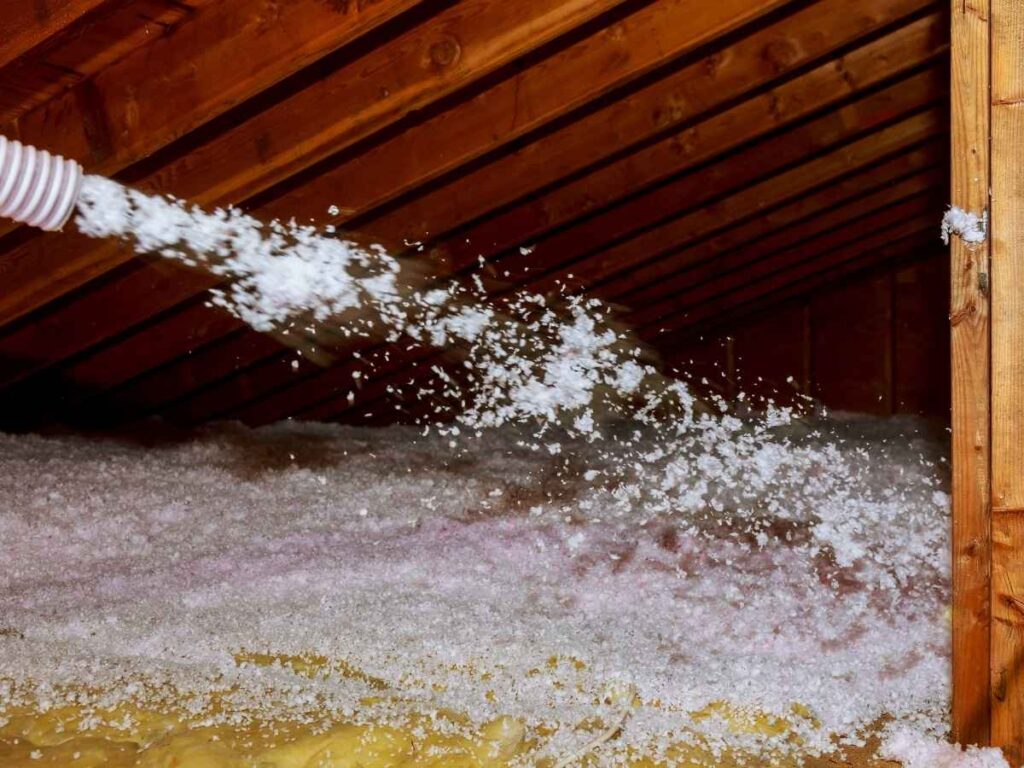
What to Expect When We Blow Insulation Into Your Attic
The work is done from a hose fed through the attic access, which keeps the equipment and the bulk of the material out of your living space. Coverage is built up gradually and checked for depth as we go rather than dumped in one pass.
We work from the furthest point back toward the hatch. That way nobody walks across finished insulation and compresses it on the way out.
How the Installation Runs
The process is fairly consistent across most residential attics.
- Assessment first — We check what is already in the attic and whether it can be covered or needs removing.
- Access protection — Floors and pathways to the attic access are covered before any equipment comes in.
- Depth marking — Reference points are set so coverage can be checked against a consistent target depth.
- Blowing the insulation — Material is distributed evenly across the attic floor, including the low edges and around obstructions.
- Final check and cleanup — Depth is verified across the space, equipment is removed and the access area is cleaned up.
How Blown In Attic Insulation May Help Your Home
Even coverage matters more than most people expect. Gaps and thin patches in an attic tend to undermine the performance of the insulation around them, which is where loose fill has a practical advantage.
How much difference you notice depends on what the attic had before and how the house is built.
What Homeowners Commonly Notice
These are the differences most often reported after a blown in installation.
- Fewer cold and hot spots — Filling the gaps around framing and edges may reduce the patchiness people notice between rooms.
- Consistent depth across the attic — Loose fill can be built up to an even level in a way batts rarely manage on an irregular floor.
- Good coverage in awkward areas — Low edges and corners that are hard to reach with batts are generally well covered.
- A workable option for topping up — Blown in material can often be added over existing insulation without removing it.
Blown In Attic Insulation at Green Leaf Insulation
Doing this well is mostly about patience and coverage discipline. Rushing the pass leaves thin patches that are invisible from the hatch but very real once the weather turns, so we check depth across the space rather than assuming it from the material used.
Working as a small owner-operated team means the same person who assessed the attic is there when it is installed. That continuity is a large part of why the finish is consistent.
Frequently Asked Questions
Is blown in insulation better than batts for an attic?
For most attic floors, loose fill has the practical edge because it settles around framing and into corners that batts cannot follow. Batts remain a strong choice for open wall cavities where the space is regular and accessible. Which is right for your project depends on the space being insulated.
Can blown in insulation be added over my existing attic insulation?
Often yes, provided the existing material is dry, undamaged and free of contamination. Adding over the top is usually more affordable than removing and starting fresh. If the existing insulation has been affected by rodents or moisture, removal generally needs to happen first.
Does blown in insulation settle over time?
Some settling is normal, and it is part of why attics that were insulated years ago now measure shallower than they once did. This is a gradual process rather than something you would notice year to year. It is also the most common reason homeowners in Florence end up adding more insulation later on.
Will blown in insulation make a mess in my house?
The equipment stays outside or in the access area, and the material is fed through a hose into the attic. Pathways and the access point are covered beforehand to keep dust contained. Some cleanup is always part of the job and it is included, not an extra.
How long does a blown in attic insulation job take in Florence?
A typical residential attic is often completed within a single visit. Larger attics, difficult access, or projects requiring removal beforehand will take longer. We will give you a realistic timeframe once we have seen the space.
See Whether Loose Fill Suits Your Attic
If your attic has thin spots, awkward corners, or insulation that has clearly settled, blown in material is often the practical answer. We will look at the space and tell you whether it is the right fit.